
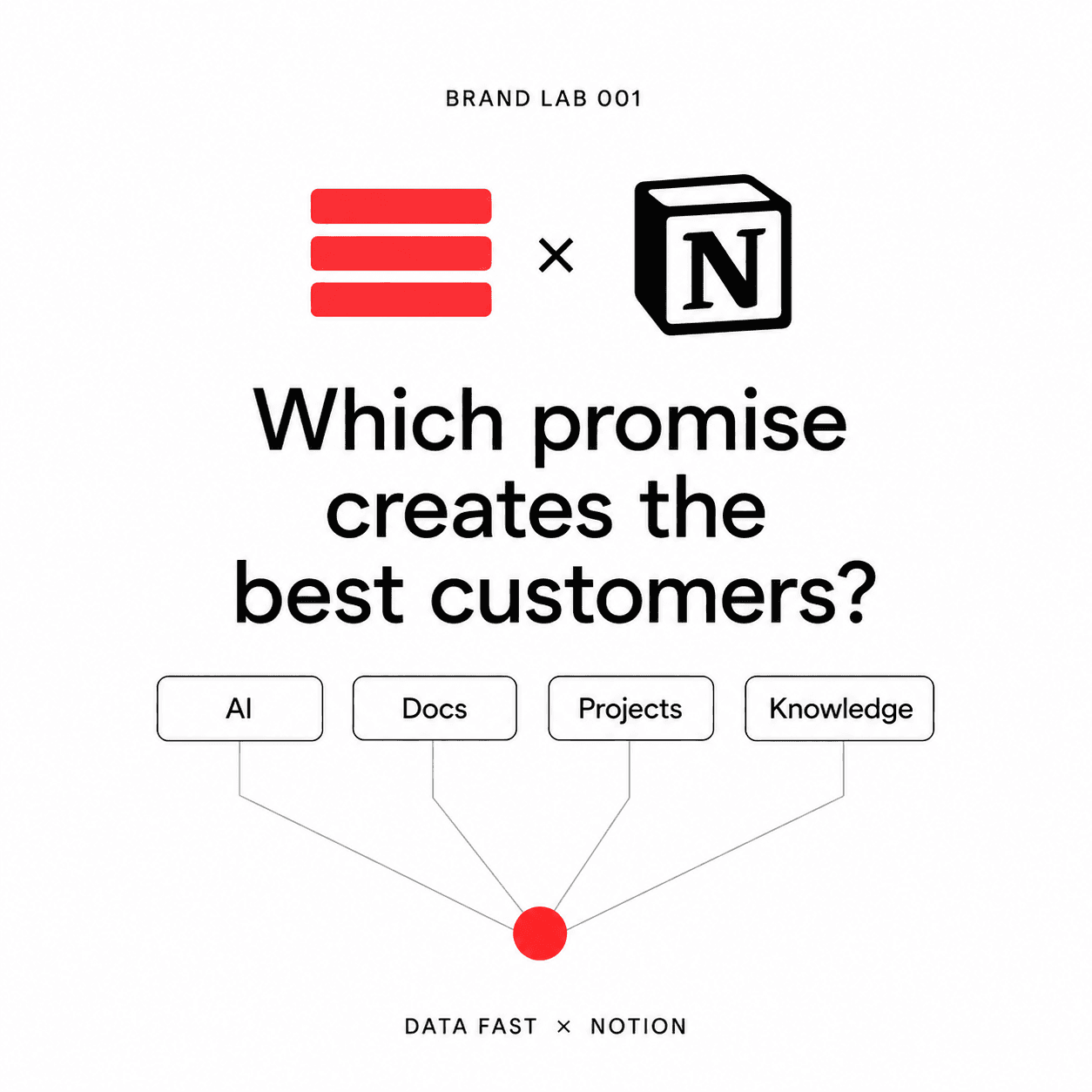
Notion is easy to recognize and surprisingly difficult to describe in one sentence. It can be a writing tool, a project manager, a knowledge base, an AI workspace, a form builder, a calendar, and a place to run a company. That range is a remarkable product advantage. It also creates one of the most interesting questions in product led growth.
When a product can solve many jobs, traffic alone cannot tell the team which story is creating durable customers. A visit attracted by an AI feature, a project template, or a company wiki may look identical in an overview chart. The value of those visits can be completely different after signup.
That is why we chose Notion for the first Data Fast Brand Lab. We reviewed its public website journey and asked what DataCrew would investigate if the full visitor, activation, and revenue signals were available. This is a measurement blueprint, not a claim about Notion’s private performance.
The real growth question
Notion’s public website presents an expansive promise. Its pricing page describes the product as one tool to run your company, while its navigation opens distinct paths for AI, agents, docs, projects, enterprise search, knowledge bases, and connections. Its Forms product alone supports feedback, requests, surveys, RSVPs, and workflow automation.
The question is not whether people are interested in Notion. The stronger question is which initial promise leads to the healthiest customer journey.
The Brand Lab questionWhich version of Notion creates the customers who activate, collaborate, return, and eventually pay?
A conventional traffic report might rank landing pages by visitors or show which campaign produced the most signups. A decision quality report would connect the first promise to what happened after signup.
What DataCrew would measure
The useful unit of analysis is not an isolated page view. It is the connected journey from a visitor’s first context to a meaningful customer outcome.
Which message, feature, template, or use case brought the visitor?
What did the visitor explore before choosing to create a workspace?
Did that workspace activate, invite collaborators, return, and convert?
For Notion, we would create audience journeys around several public entry points: AI and automation, project management, company knowledge, forms, and personal organization. Each journey would retain its original acquisition source and landing promise through signup, activation, and revenue.
This would let a growth team answer questions that aggregate analytics hides:
- Which product promise produces the highest activation rate?
- Which landing pages attract individual curiosity but fail to create recurring use?
- Which audience invites teammates fastest?
- Which social and search campaigns create paying teams instead of temporary signups?
- Where do high intent visitors pause between pricing and workspace creation?
Four founder playbooks, one decision
Data is evidence, not a strategy by itself. DataCrew’s AI advisor uses relevant ideas from the Founder’s Playbook to turn a pattern into a testable next move.
Positioning depends on context. A project manager, a founder, and an enterprise knowledge leader compare Notion with different alternatives. Their landing experiences should acknowledge that context.
A visitor should quickly understand the outcome and the next action. Broad capability can remain the brand story while campaign pages make one job unmistakably clear.
A channel earns investment when it repeatedly creates valuable customers. Reach and clicks are early signals, not the final score.
Treat each landing journey as a measurable experiment. Keep the change small, define activation before launch, and learn before expanding it across the site.
The experiment we would run
We would preserve Notion’s broad homepage while creating four focused journeys for paid campaigns, social posts, high intent search terms, and partner referrals.
- 01Choose four intents
AI and automation, projects, company knowledge, and forms.
- 02Match one promise to each intent
Lead with the outcome that visitor is already trying to achieve, then show how the wider workspace supports it.
- 03Define activation before launch
Use a meaningful product action, not account creation alone. The event might involve creating a first workflow, importing knowledge, or inviting a teammate.
- 04Connect the complete journey
Keep acquisition source, landing promise, pricing behavior, signup, activation, retention, and revenue in one view.
- 05Invest behind the winning journey
Scale the audience and message that produces durable customers, then repeat the experiment for the next segment.
Not the landing page with the most visitors. The journey that consistently creates activated customers with healthy paid conversion.
What every multi-product company can learn
This analysis is about Notion, but the problem is common. As products expand, the homepage accumulates audiences, features, and promises. Teams often continue optimizing one blended funnel even though visitors are making very different decisions.
A better growth system preserves the visitor’s original context. It shows which story brought them, how they moved through the product, and whether that journey created business value.
DataCrew is built for that connected view. It combines website analytics, visitor journeys, acquisition, goals, funnels, revenue, and an AI advisor grounded in proven founder playbooks. The objective is simple: understand what happened, explain why it matters, and choose the next measurable move.